


Equine Bodywork: Busting the Biggest Myths (And What Your Horse Actually Needs)


If you’ve spent any time in the horse world, you’ve probably heard it all. “No pain, no gain,” “You need deep pressure to make a difference,” or “If the horse doesn’t react, nothing is happening.”
These beliefs have been around for a long time. But that doesn’t mean they’re accurate or helpful.
Let’s break down some of the most common myths in equine bodywork, and what your horse actually needs to feel and perform at their best.
Myth #1: No Pain, No Gain

This is one of the most ingrained beliefs in the equine industry. The idea that discomfort is necessary for improvement.
Truth: Horses don’t need to experience pain to release tension.
In fact, when a horse feels pain or excessive pressure, the nervous system often shifts into protection mode, bracing, guarding, and resisting. That’s the opposite of what we want.
Real, lasting change happens when the body feels safe enough to let go.
Myth #2: More Pressure Means Deeper Work
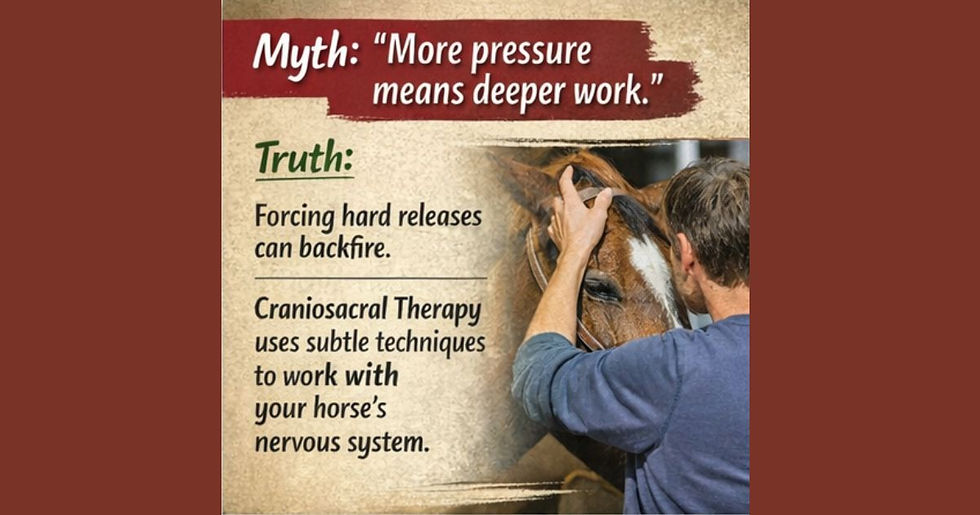
It’s easy to assume that stronger pressure equals more effective results.
Truth: More pressure often creates more resistance.
A horse’s body is incredibly sensitive and responsive. Gentle, intentional work can access deeper layers without triggering a defensive response.
When we work with the nervous system instead of against it, we create space for real release, not forced change.
Myth #3: If You Don’t See a Big Reaction, It’s Not Working
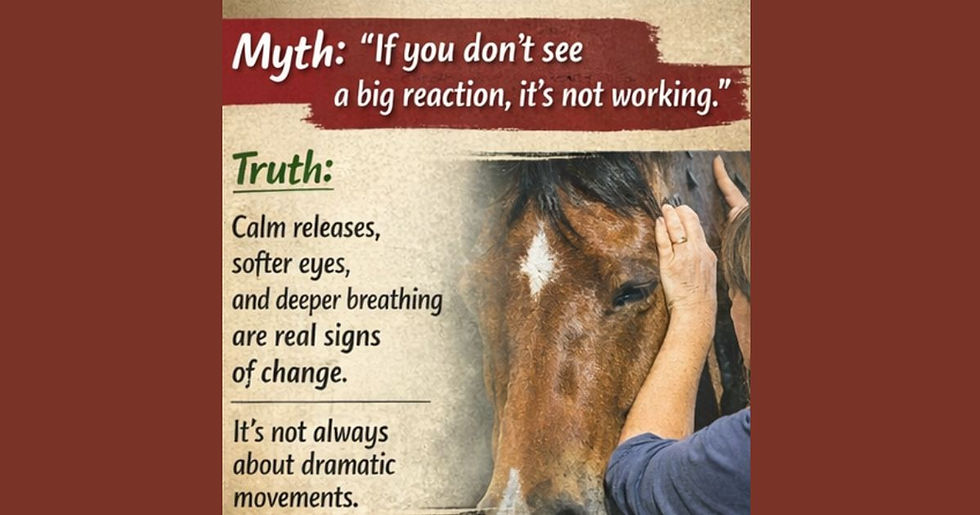
People often expect dramatic responses like licking, chewing, big movements, or visible releases.
Truth: Subtle shifts are often the most meaningful.
Soft eyes, a lowered head, deeper breathing, or a quiet stillness are still powerful signs that the nervous system is regulating and the body is releasing tension.
Not all healing is loud. In fact, most of it isn’t.
Myth #4: Bodywork Is Just a “Nice Extra”
Some view bodywork as optional, something you do occasionally, rather than an essential part of care.
Truth: The body and nervous system influence everything.
Movement, performance, behaviour, recovery, and even how your horse processes stress are all connected.
Supporting the body before issues become obvious can help prevent compensation patterns and discomfort down the line.
Myth #5: The Practitioner Fixes the Horse
It’s common to think the practitioner is the one doing the fixing.
Truth: Your horse’s body is doing the work.
A skilled practitioner is there to listen, follow, and support, not force or override.
Your horse already has an innate ability to heal and regulate. The right kind of bodywork simply creates the conditions for that to happen.
So… What Does Your Horse Actually Need?
Not more force. Not more pressure. Not more intensity.
What your horse truly needs is:
a nervous system that feels safe
a body that isn’t being pushed past its limits
space to release tension without resistance
support that works with them, not against them
This is where gentle, integrative approaches like craniosacral therapy and intuitive bodywork can make a profound difference.
A Different Way to Look at Healing
The equine industry is evolving. We’re learning that bigger, stronger, and more forceful isn’t always better.
Sometimes the most effective work is the quietest.
When you start to see your horse not as something to fix, but as a partner whose body is constantly communicating, everything shifts.
Curious What This Could Look Like for Your Horse?
Every horse is different. Every session is different.
If you’re curious about a more gentle, nervous system focused approach to bodywork, we’d love to support you and your horse.
Reach out to book a session or ask questions. We’re always happy to chat about what your horse might need.
Contact us at info@balancedbodyworks.ca.


Comments